
You ran the buddy program. You set up the coffee chat rotation. You sent the icebreaker Slack messages.
Three months later, your team still feels disconnected. New hires still say they don’t know who to ask. Remote employees still feel invisible. Engagement scores haven’t moved.
Here’s the harder question: what is that actually costing you?
According to Gallup, low engagement costs companies $3,400 for every $10,000 in salary. New hires who don’t build real connections in their first 90 days take significantly longer to reach full productivity. Knowledge that should flow across teams gets stuck, duplicated, or lost entirely. And replacing an employee who quietly checks out runs anywhere from 50% to 200% of their annual salary.
Connection programs were supposed to fix this. For most companies, they aren’t working.
The problem is not effort. The problem is that most connection programs are built on random matching, and random introductions deliver random results.
Why Random Connection Programs Don’t Create Business Value
A random connection program feels like progress. Calendar invites go out. People show up to coffee chats. HR can report that hundreds of introductions were made this quarter.
But unless those introductions are creating real value for the business and for the people having the conversations, they are just filling calendars.
Here is what research consistently shows about connection that actually works:
For the company: Employees with strong internal networks contribute more cross-functionally, adapt faster to change, and are significantly harder to recruit away. Teams with strong internal ties make decisions faster because information flows instead of getting stuck in silos. According to Gallup, new hires who build connections in their first 30 days are twice as likely to still be with the company a year later.
For the employee: Internal networks are career infrastructure. The people who get promoted, get pulled into high-visibility projects, and get sponsored for new opportunities are almost always the people with the right internal relationships. Finding a mentor, a collaborator, or someone who has navigated the same challenge before saves weeks of guessing. That is not a soft benefit. That is real time back in someone’s day.
When a connection program delivers this, it is one of the highest-ROI investments in your people stack. When it doesn’t, it becomes a calendar burden, and eventually people stop showing up.
What Strategic Connection Means for Both the Business and the Employee
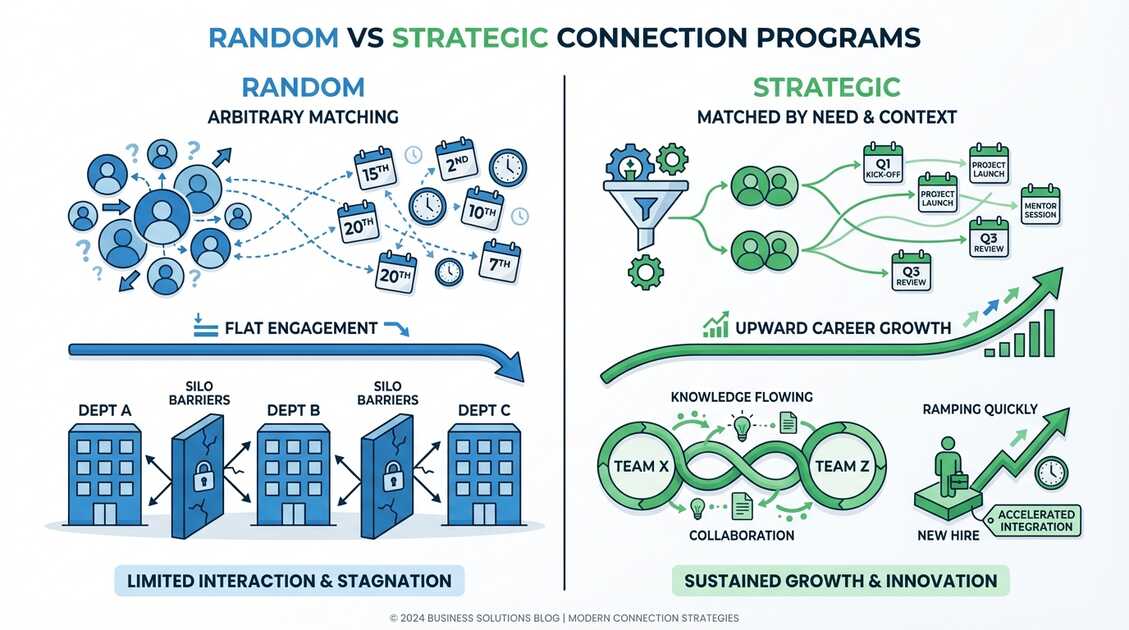
Strategic connection means connecting people based on what they need and what they can offer, not based on who they haven’t met yet.
Think about how good managers make introductions. They don’t say “you two should meet.” They say: “You should talk to Priya. She ran the exact onboarding transition you are about to go through and she will save you three weeks of guessing.”
That introduction delivers business value because the new hire ramps faster. It delivers personal value because the new hire gets real guidance and Priya gets visibility as a knowledge leader inside the company. Both people leave with something.
The goal of a strategic connection program is to make that kind of introduction systematically, for every new hire, every cross-team collaboration, and every knowledge gap that is slowing someone down.
Three Signs Your Program Is Generating Activity But Not Value
Sign 1: You match people by tenure or department, not by need.
Matching someone to a buddy because they have been at the company less than 90 days is a category, not a reason. Matching without context creates conversations with no stakes. Conversations with no stakes rarely lead to follow-up. And without follow-up, no value is created for anyone.
Sign 2: You track completions, not outcomes.
“200 coffee chats completed this quarter” tells you that meetings happened. It does not tell you whether those meetings changed anything: whether someone got unblocked, whether knowledge moved across a silo, whether a new hire now has a real working relationship or just a name in their contact list.
Sign 3: You find out too late when the program isn’t working.
The first signal is usually a resignation, a low engagement score, or a manager flagging that someone seems checked out. At that point, the cost of replacement, lost knowledge, and team disruption is already locked in.
What Value-Driven Connection Looks Like in Practice
Faster Onboarding ROI
The typical new hire takes three to six months to reach full productivity. A significant part of that delay is not a learning curve. It is navigation. Strategic connection shortens that time by giving new hires access to colleagues who have solved the same problems, informal experts who do not appear in the org chart, and peers who have been through the same transition.
Business result: New hires contribute faster. The cost of the ramp period drops. First-year retention improves.
What the employee gets: Real relationships from day one, not just a buddy who gives them the official version of how things work.
Knowledge That Flows Across Teams
Every organization has knowledge silos. Product builds something sales doesn’t know about. Customer insights sit in support and never reach product. These are not communication failures. They are connection failures. The right people simply don’t know to find each other.
Business result: Fewer decisions made without the right information. Less duplicated work. Faster response when something changes.
What the employee gets: Visibility. The subject matter expert doing great work in isolation gets found. Both people gain something from the interaction.
Retention Among People Worth Keeping
According to Gallup, employees with a best friend at work are seven times more likely to be engaged in their jobs and significantly less likely to leave. Those relationships do not form randomly. They form when people have real reasons to interact: shared challenges, complementary skills, and mutual relevance.
Business result: Lower voluntary turnover, particularly among high performers and new hires. Lower replacement costs across the board.
What the employee gets: A workplace worth staying in. The kind of internal network that opens doors to opportunities they would not have found otherwise.
Four Shifts That Make Connection Programs Work
Shift 1: Match by need, not by category. Every introduction should have a reason that both people understand. That reason creates stakes, and stakes lead to follow-through.
Shift 2: Measure outcomes, not activity. Are new hires building connections outside their immediate team? Are isolated employees getting found before they disengage?
Shift 3: Design for context, not one-size-fits-all. A new hire needs different connections than a mid-career employee navigating a role change. Programs that treat everyone the same generate average results for everyone.
Shift 4: Run continuously, not periodically. The highest-value connection programs surface the right introduction at the right moment, not on a quarterly rotation.
A Practical Path Forward for HR Teams
Weeks 1 and 2: Audit your current program with a value lens. For each type of introduction you are making, ask: what value does this create for the business and for the person receiving it?
Weeks 3 and 4: Add one context filter before the next matching cycle. Group people by role challenge, project type, onboarding milestone, or knowledge need. Even one shared filter significantly improves conversation quality.
Month 2: Start tracking who is not connecting. Flag employees with zero meaningful connections after 60 days. Flag teams that never appear in cross-department introductions.
Month 3 and beyond: Let the system run automatically. This is where LEAD.bot comes in. It automatically finds the right people for the right conversations across Slack and Microsoft Teams, so the program delivers value without becoming a full-time job.
The Bottom Line
Connection programs do not fail because HR teams are not trying. They fail because random introductions generate random results, and the business and personal value that justifies running the program never materializes at scale.
When introductions are driven by actual need, when both sides have something to gain, and when you are measuring outcomes instead of activity, the results look different.
New hires ramp faster. Knowledge moves across teams. High performers stay. People who have been doing great work in isolation get found.
The shift is not complicated. It is intentional.
Try LEAD.bot
LEAD.bot automatically finds the right people for the right conversations across Slack and Microsoft Teams. Whether you are onboarding new hires, closing knowledge gaps, or trying to understand who knows what inside your organization, LEAD.bot handles the matching so you do not have to.
Setup takes less than a day. Running the program takes about five minutes a month.