You’ve seen it before: someone joins your Slack workspace, gets randomly paired with a colleague for “virtual coffee,” they exchange a few awkward pleasantries, and… nothing. No follow-up. No collaboration. Just another 30-minute meeting that could’ve been an email.
If your company uses random coffee chat tools, you’re not alone. The employee connection app market is crowded—20+ platforms promise to “foster meaningful connections” through automated pairings. Donut alone reports 20,000+ teams using their platform. CoffeePals counts LinkedIn, Ikea, and Pernod Ricard among their customers.
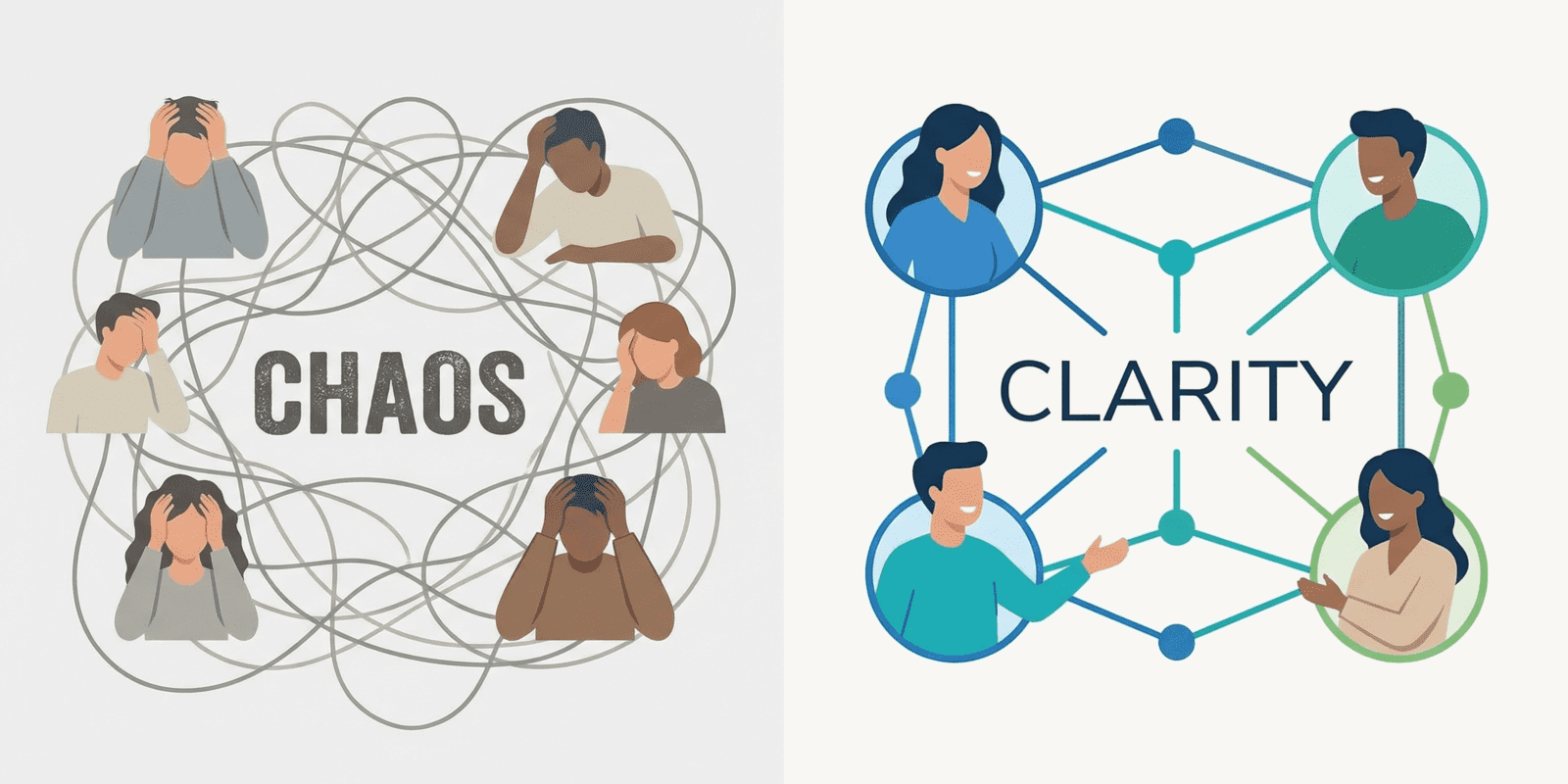
But here’s the uncomfortable truth: random matching works great for small teams (under 50 people). At enterprise scale? It creates noise, not connections.
Let me explain why—and what actually works when you’re trying to connect hundreds or thousands of employees.
The Hidden Cost of Random Matching
Random coffee chats fail at scale for three reasons most companies discover too late:
1. Context collapse.
When you pair a junior engineer in Austin with a senior sales director in London, what exactly are they supposed to talk about? Without shared context—projects, goals, challenges—conversations default to small talk. And small talk doesn’t build the kind of connections that improve collaboration or reduce silos.
Small companies don’t face this problem. When you’re 30 people, everyone already knows what everyone else does. Random pairings add serendipity. But at 3,000 people? You’re asking strangers to create meaningful connection in a 30-minute Zoom call. It rarely works.
2. Misaligned incentives.
Here’s what typically happens: HR launches a connection program with great intentions. Week one, participation is high (it’s new and shiny). Week four, calendar invites pile up. Week eight, people start declining matches because they’re “too busy.”
The problem isn’t that employees don’t value connection. It’s that random pairings don’t align with their actual work needs. If I’m onboarding and need to understand our product architecture, a coffee chat with someone from marketing isn’t helpful—it’s a distraction.
Enterprise employees are drowning in meetings. They’ll only prioritize connection activities that serve a purpose beyond “networking for networking’s sake.”
3. Measuring the wrong thing.
Most connection tools report one metric: number of matches made.
But matches don’t equal meaningful connections. Did those two people ever collaborate after their coffee chat? Did the new hire actually learn something useful during onboarding? Did cross-team pairings reduce silos or just add calendar clutter? According to Harvard Business Review onboarding research, this trend continues to reshape the workplace.
Without measuring connection quality—not just volume—you have no idea if your program is working. And if you can’t prove ROI, the budget disappears during the next cost-cutting cycle.
What Works Instead: Structured Connection Programs
The companies that succeed with employee connections at scale don’t rely on randomness. They build structured programs with clear purposes.
Here’s what that looks like:
Purpose-driven matching.
Instead of “meet a random colleague,” successful programs create context:
- Onboarding buddies: New hires paired with experienced employees in similar roles (not random departments). The goal isn’t networking—it’s learning how things actually work.
- Mentorship programs: Junior employees matched with senior folks based on career goals and skills gaps (not random seniority levels).
- Cross-team collaboration: When two departments need to work together, structured introductions replace cold emails.
Notice the pattern? Every connection has a purpose beyond “fostering engagement.” That purpose gives people a reason to show up and a framework for conversation. Research from Harvard Business Review highlights this growing trend. Research from McKinsey’s organizational insights supports this approach.
data-driven matching (not random).
Random matching treats all employees as interchangeable. But a software engineer onboarding into your payments team needs different connections than someone joining your marketing team.
Smarter programs use structured data—roles, skills, interests, team memberships, project involvement—to create relevant pairings. This isn’t about complex algorithms. It’s about asking: “What does this person actually need right now, and who can help?”
Some platforms are starting to offer this. Most still default to randomness because it’s easier to build. But “easier to build” doesn’t mean “better for users.”
Connection quality metrics.
If you can’t measure it, you can’t improve it. The best programs track:
- Follow-up rate: Did matched employees interact again after their initial meeting? (If not, the pairing probably wasn’t valuable.)
- Collaboration impact: Did onboarding buddies reduce time-to-productivity? Did cross-team pairings lead to project collaboration?
- Retention signal: Do employees with stronger connection networks stay longer? (This matters for onboarding programs especially.)
- Program engagement: Are people showing up, or are they declining invites?
These metrics are harder to track than “matches made.” But they tell you whether your program is actually working—or just creating calendar noise.
Why This Matters for Slack and Microsoft Teams Users
If your company runs on Slack or Microsoft Teams, you already have the infrastructure for connection programs. The question is whether you’re using it strategically.
Most connection tools bolt onto Slack/Teams as another app to manage. The better approach? Enhance the workflows people already use:
- Onboarding buddies get introduced in the new hire’s team channel (not a separate DM).
- Mentorship pairings integrate with existing 1:1 meeting cadences (not another calendar invite).
- Cross-team connections surface in project channels when collaboration is needed (not random intros).
The companies that do this well—LinkedIn, Ikea, and others running structured programs—don’t treat connection tools as standalone platforms. They treat them as enhancements to communication infrastructure.
That’s the difference between a program that sticks and one that gets abandoned after three months.
The Enterprise Reality Check
If you’re running connection programs at a large company, you also face constraints small teams don’t:
- Compliance and audit trails: Who got paired with whom? Did we avoid pairing people with reporting relationships? Can we prove our mentorship program follows DE&I guidelines?
- Program reporting: Leadership wants to know if this is working. “We made 500 matches” isn’t an answer. “Onboarded employees with buddies reached productivity 30% faster” is.
- Privacy controls: Employees need to opt in (not get auto-enrolled). Some regions have strict data privacy rules.
Random coffee chat tools work great for startups. Enterprise programs need structure, governance, and measurable outcomes.
What to Do Next
If you’re rethinking your employee connection strategy, here’s where to start:
- Audit your current program. Are you measuring matches or outcomes? If people are declining invites, why?
- Pick one use case. Don’t try to solve “connection” broadly. Start with onboarding, mentorship, or cross-team collaboration—pick the one with the clearest business impact.
- Define success metrics. What does “meaningful connection” actually mean for this use case? How will you know if it’s working?
- Test structured matching. Try purpose-driven pairings (based on role, team, or goals) instead of random matching. Measure the difference.
- Integrate, don’t add. If your team lives in Slack or Teams, build connection programs into those workflows. Don’t make people manage another platform.
The goal isn’t to create more meetings. It’s to create the right connections—ones that help people do their jobs better, onboard faster, and feel less isolated in large organizations.
Random coffee chats can’t do that at scale. Structured programs can.
Ready to build connection programs that actually work? LEAD.bot helps enterprise teams running on Slack and Microsoft Teams create structured onboarding, mentorship, and cross-team connection programs—with the governance and reporting features large companies need. Learn more at lead.app/blog.